
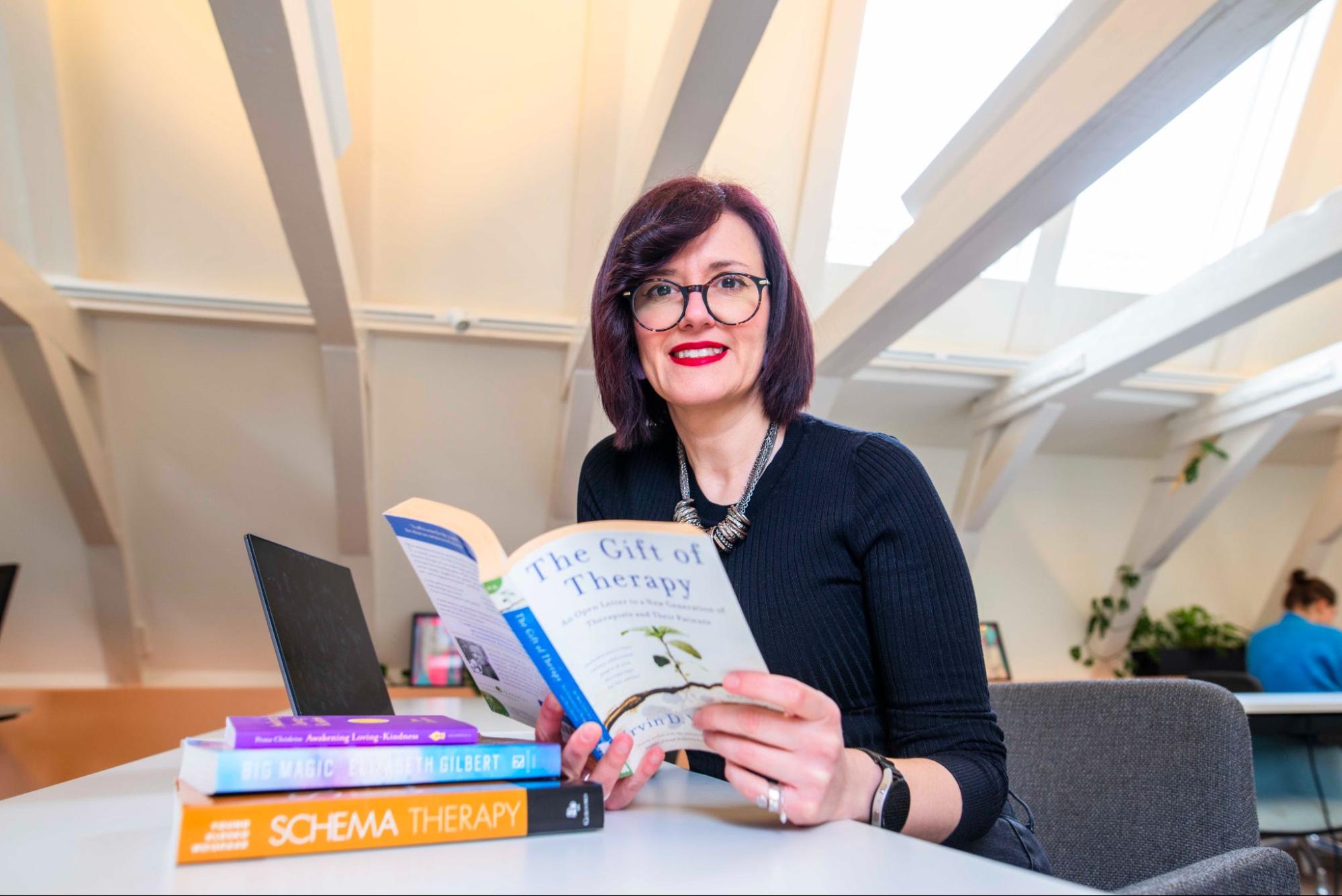
Vassia Sarantopoulou: The Psychologist Behind AntiLoneliness
Meet Vassia Sarantopoulou: The Psychologist Behind AntiLoneliness
For nearly two decades, psychologist Vassia Sarantopoulou has worked with high achievers, expats, and perfectionists whose lives looked successful on the outside but felt quietly disconnected on the inside. That work became the foundation for AntiLoneliness.
You Built the Life Everyone Envies. So Why Does It Feel So Empty?
There’s a woman sitting in a café in Leiden. She has a master’s degree, a career she’s proud of, two children, a life she chose in a country she loves. She speaks the language well enough, her calendar is full enough, her LinkedIn looks more than enough.
And yet she hasn’t had a conversation that felt real in months. She won’t tell anyone. Because when you’ve voluntarily left your country, built something from nothing, and checked every box that’s supposed to add up to a good life, admitting you’re lonely feels like handing people a reason to dismiss everything you’ve worked so hard for.
Suddenly your career, your courage, your whole life abroad becomes “but at what cost?” So you perform connection. You show up to networking events and say the right things. You say “we should catch up soon” and never do. You post the brunch photo. And you sit in your apartment afterward wondering why none of it reaches the part of you that’s actually hurting.
This isn’t a rare story. It’s the type of story Vassia Sarantopoulou hears in her practice daily.
And it reflects a broader global crisis. The World Health Organization now estimates that 1 in 6 people worldwide experience loneliness. In June 2025, WHO’s Commission on Social Connection released a landmark report linking loneliness to an estimated 871,000 deaths every year, roughly 100 deaths every hour. People who are lonely are twice as likely to develop depression. Lacking genuine social connection carries health risks comparable to smoking 15 cigarettes a day.
But the version of loneliness nobody is talking about isn’t the kind that looks like isolation. It’s the kind that hides behind a full calendar, a high-achieving career, and a life that was deliberately, courageously chosen.
The Psychologist Who Founded AntiLoneliness
Vassia didn’t call her practice “AntiLoneliness” because it was clever branding. She called it that because, after nearly two decades of clinical work, she kept seeing the same invisible crisis: the people who looked most connected were often the most alone.
High achievers. Expats. Perfectionists. People whose lives looked full on the outside and felt hollow on the inside.
That observation became the foundation for AntiLoneliness, a mental health collective built around the people she kept meeting in her therapy room.
Born in Greece and later settling in the Netherlands, Vassia understands the expat experience personally as well as professionally. For nearly two decades, she’s helped people build deeper relationships with others and, just as importantly, with themselves through Schema Therapy, Emotionally Focused Therapy, CBT, ACT, and Compassion-Focused Therapy.
Today, AntiLoneliness includes a team of 16 psychologists from the Netherlands, Belgium, USA, Romania, Croatia, the UK, Spain, Portugal, Germany, Greece, and Philippines, serving clients in person across Leiden, The Hague, Utrecht and other cities of the Netherlands, and online worldwide.
Why High Achievers Are Often the Loneliest People in the Room
Many of the people Vassia works with aren’t struggling because they lack social skills. They’re struggling because the way they learned to relate to other people was shaped long before adulthood.
Schema Therapy describes these as “early maladaptive schemas,” deeply rooted emotional patterns that influence how we connect, protect ourselves, and make sense of relationships. For many high achievers and perfectionists, those patterns carry a familiar message: love is conditional on performance. Be useful. Be impressive. Don’t burden anyone. Earn your place.
Over time, those beliefs can create a life filled with relationships that function well on the surface but never quite satisfy the deeper need to be known. You have colleagues who respect you, friends who invite you to dinner, a partner who says the right things, and yet some part of you still feels unseen because no one is relating to the person underneath the performance.
Vassia has written extensively about the relationship between perfectionism and loneliness. Perfectionism, she argues, isn’t simply having high standards. It’s the pressure to appear flawless and the exhausting work of maintaining that image. When connection depends on performance, loneliness can persist even in a life surrounded by people.
What Makes Expat Loneliness Different
Moving abroad adds another dimension to loneliness.
Expats leave behind the people who knew them before the career, before the move, before the version of themselves they’ve worked so hard to become. New friendships are built across languages, cultures, and unfamiliar routines. They can become deep and meaningful, but they rarely carry the shared history of relationships that have been growing for years.
For many expats, loneliness comes with an added sense of guilt. They chose this life. They’re supposed to be grateful, adventurous, thriving. Admitting they’re lonely can feel like admitting the decision itself was a mistake.
Vassia understands that tension personally as well as professionally. After moving from Greece to the Netherlands, she eventually became a Dutch citizen, a milestone she has said deepened her own sense of belonging. Today she works with adults, couples, and entrepreneurs in both English and Greek, helping people navigate not only relationships, but also the emotional complexity of building a life far from where they began.
How AntiLoneliness Grew from Solo Practice to Global Movement
What began as a solo practice has grown into something much larger. Today, AntiLoneliness includes a team of 16 psychologists from the Netherlands, Belgium, USA, Romania, Croatia, the UK, Spain, Portugal, Germany, Greece, and Philippines, serving clients in person across Leiden, The Hague, Utrecht and other cities of the Netherlands, and online worldwide.
But therapy was never meant to be the only place people found support.
Vassia created the AntiLoneliness Academy to make evidence-based psychological tools more accessible through courses on perfectionism, burnout, boundaries, conflict, procrastination, and self-sabotage. Since 2016, her “Starting Over” divorce groups have helped people navigate one of life’s most isolating transitions, while the Therapy Business Circle supports therapists building ethical, sustainable practices across Europe.
Her work has also reached audiences well beyond the therapy room through podcasts, publications, international conferences, and workshops, helping bring conversations about loneliness, perfectionism, and belonging into the broader public conversation.
Building Connection from the Inside Out
Vassia encourages people to think about loneliness differently.
Rather than seeing it as a personal failure, she sees it as information. A signal that something essential is missing from the relationships in someone’s life: depth, belonging, and the experience of being truly known.
Many people arrive believing they need more friends, more networking, or a busier social life. Instead, they discover they’ve spent years relating to the world through performance rather than authenticity. Before deeper relationships with others become possible, they often have to rediscover who they are underneath the version that’s always trying to earn acceptance.
Schema Therapy helps uncover the emotional patterns that quietly shape adult relationships. Combined with Emotionally Focused Therapy and ACT, it moves beyond helping people cope with loneliness. It begins by understanding what’s underneath the loneliness and building connection from the inside out, allowing people to create relationships that feel more honest, secure, and connected.
Because loneliness, as Vassia sees it, isn’t the absence of people.
It’s the absence of being known.
To learn more about Vassia and AntiLoneliness, visit https://antiloneliness.com. Clients can also book with Vassia directly on Trova Health:
Join Vassia’s upcoming class for practitioners: 5 Schema Therapy Interventions for Chronic Loneliness You Can Use Immediately on September 30, 2026.
Published by Trova Health, a clinician-built global network of mental health and wellness professionals working to make culturally informed care more accessible worldwide. Our Provider Spotlight series shares the stories of clinicians who bring something exceptional to their work, wherever in the world they practise.
FAQs
What is the loneliness epidemic?
The loneliness epidemic refers to the growing public health crisis of chronic social disconnection. In 2023, the U.S. Surgeon General declared loneliness an epidemic, noting that approximately half of American adults report feeling lonely. The World Health Organization has also identified it as a pressing global health threat. It affects not only the isolated but increasingly high achievers, expats, and perfectionists whose loneliness is invisible because their lives look successful from the outside.
What is AntiLoneliness?
AntiLoneliness is a mental health collective founded by psychologist Vassia Sarantopoulou in the Netherlands. It includes a team of 16 psychologists from five countries, serving expats and international clients in-person across Leiden, The Hague, and Utrecht, and online worldwide. It also includes an online academy, weekly divorce support groups, and a therapist mentoring community called the Therapy Business Circle.
What is expat loneliness?
Expat loneliness is a specific form of chronic disconnection experienced by people who have moved abroad voluntarily. It is compounded by the loss of existing support networks, relationships built across language and cultural barriers, and the belief that expats aren’t allowed to feel lonely because they chose their situation. It is a core focus of AntiLoneliness and Vassia Sarantopoulou’s clinical work.
Can therapy help with loneliness?
Yes. Schema Therapy, Emotionally Focused Therapy (EFT), and ACT are evidence-based approaches that address the deep psychological patterns, including perfectionism, people-pleasing, and conditional self-worth, that create and sustain chronic loneliness. These are the primary modalities used at AntiLoneliness.
How does Schema Therapy treat loneliness?
Schema Therapy identifies early maladaptive schemas, deep patterns formed in childhood, that shape how adults connect in relationships. For high achievers and perfectionists, a common schema is that love is conditional on performance. Schema Therapy works to uncover and heal these patterns, enabling more genuine connection rather than performative relating.
Is loneliness a mental health condition?
Loneliness is not a diagnosis but a significant psychological experience with serious health consequences. The WHO notes that lonely people are twice as likely to develop depression, and the U.S. Surgeon General found that chronic loneliness carries health risks comparable to smoking 15 cigarettes a day. Vassia Sarantopoulou’s clinical approach treats loneliness as a primary presenting issue rather than a symptom of something else.
Can I see an English-speaking psychologist online in the Netherlands?
Yes. Vassia Sarantopoulou and the AntiLoneliness team offer online sessions for clients seeking support with loneliness, perfectionism, burnout, relationship issues, and expat life. Sessions are available in English and other languages through AntiLoneliness and Trova Health.
What is the difference between loneliness and social isolation?
Social isolation is the objective lack of social contact. Loneliness is a subjective experience, the painful feeling that arises from a gap between the connections you have and the connections you need. You can be socially isolated without feeling lonely, and you can feel profoundly lonely while surrounded by people.